Selecting Judges

This is a public service announcement. The selection process for judges in Nebraska in no way resembles what we saw this week with the U.S. Senate Judiciary Committee hearings.

Last week I was sitting in the Nebraska Supreme Court hearing room. It is one of the most beautiful rooms in the Nebraska Capital. The chamber is acoustically perfect, aided by the 8000 piece carved walnut ceiling. It is my favorite room in the Capital.  As I sat there listening to candidates for the Lancaster County Court bench, I thought how grateful I am that the judicial selection process in Nebraska remains thorough, dignified, polite, bipartisan, and fair.

Supreme CourtSupreme Court Room

In Nebraska we use what is called the Missouri Plan for the selection of judges. “[T]here are judicial nominating commissions for the chief justiceship, for each district of the supreme court, court of appeals, . . . district court, [county court, and separate juvenile courts], making a total of thirty-three commissions. Each nominating commission consists of four lawyers elected by [their fellow lawyers], four non-lawyers appointed by the governor, and a supreme court justice who serves as a non-voting chair. No more than two lawyers and two non-lawyers may be members of the same political party. Commission members serve staggered, four-year terms.” National Center for State Courts.  There are four alternate lawyers and four alternate non-lawyers selected in the same manner.

Last week I was sitting as an alternate member of the Commission, although I have previously served as a voting member of the Commission. As an alternate I sat through all the public and closed proceedings and had access to the same information as voting members. Alternates are dismissed before the final selection process after it is clear that no voting members have conflicts of interest.

We heard each candidate speak in public and tell us why they felt they should be on the court; there was an opportunity for the public to speak in favor or opposed to each candidate. We interviewed each candidate in private and addressed any concerns of the Commission members. We received an application from each candidate, information about any complaints filed against them,  their credit reports, ratings (kept confidential from even the candidates) from judges and fellow attorneys, and letters of recommendation submitted on behalf of the candidates. We did not embarrass anyone in public, and there was no yelling by anyone. Each Commission member asked their own questions. No “female or male assistant” asked questions of the candidates.

After the other alternates and I left, the Commission recommended four candidates to the Governor, who will make the final decision on who will be appointed to the bench. Some might think the final piece of this process will be political, and it might. But because of the work of the Judicial Nominating Commission in this case and in every judicial appointment in Nebraska, we can be sure that the final candidates have been thoroughly vetted by a fair and bipartisan process. These candidates have been found to be competent and qualified to serve as a judge. It isn’t a perfect process, but after last week, I think it beats the way we select Justices for the United States Supreme Court.


“Just shut up and step up. Do the right thing, for a change.”

“I just want to say to the men in this country: Just shut up and step up. Do the right thing, for a change”, said U.S. Senator Mazie Hirano on September 18, 2018. Senator Hirano speaks for me, and I think she speaks for many in this country.

Professor Christine Blasey Ford has stated that Supreme Court candidate Brett Kavanaugh assaulted her when he was 17 and she was 15. I believe her. And more to the point, I think Judge Kavanaugh lied when he denied this assault ever took place. But I am not the judge or jury here. Unfortunately, that is left to the members of the U.S. Senate Judiciary Committee who are unwilling to even give Dr. Blasey a fair investigation by the FBI. This includes our own Senator Ben Sasse, who is too busy writing ethics bills and criticizing the ethics of others to look at himself and what he and his fellow committee members are doing.

Women who come forward to testify against their assailants are vilified in the news media and social media, harassed, and threatened. Dr. Blasey has had to leave her home and take steps to protect her family. A GoFundMe fundraiser for Dr. Blasey’s security costs has at the time I am writing this blog post raised over $200,000 from over 6,000 individuals.

Senators have asked why Dr. Blasey didn’t come forward sooner. The story of what happened to 16 year old Amber Wyatt when she reported her rape by two high school senior athletes will tell you everything you need to know about why a girl would choose not to report an assault. Ms. Wyatt’s ordeal began 12 years ago after she reported the rapes, went to the hospital for a rape exam, and was interviewed by local law enforcement. No charges were ever brought, and she was driven out of her high school. This story is a must read.

As a baby prosecutor I worked with a group to educate the public about sexual assault. I spoke to men’s service groups (you know, the ones with animal names) in the 1980’s. I learned first hand how hard it was to talk about sexual assault in front of a group, and I wasn’t a victim describing what had happened to me. All the groups I talked to were polite and listened intently. I could see them thinking about how an assault victim could be their wife, their sister, their daughter, and even their mother. I believe that the hearts and minds of people can be changed.

Attorney Rachel Denhollander was the first woman to come forward to bring charges against Michigan State doctor and convicted pedophile Larry Nassar. She said, “I lost my church. I lost my closest friends as a result of advocating for survivors who had been victimized by similar institutional failures in my own community. I lost every shred of privacy.” Her story is sobering and well worth the read.

This is why women and girls do not want to come forward to testify. This is why anyone who says Dr. Blasey is making this up does not fully understand what her testimony is costing her today and will cost her forever. Dr. Blasey is not “mixed up” as Senator Orrin Hatch alleges.

Chief Counsel Carrie Severino of the Judicial Crisis Network calls the assault described by Dr. Blasey as “rough horseplay”. The Network is spending $1.5 million dollars to get Judge Kavanaugh confirmed. More on the Judicial Crisis Network can be found at my blog post I don’t care what Jane thinks!

In a very clever opinion post, Alexandra Petri writes, “I am a horse. I know horseplay. That’s not what this is.” Her post put the only smile on my face about this subject.

I can imagine that a 17 year old boy could get drunk, assault a girl, and be embarrassed about it since he is now a powerful judge. What I do not understand is how he can not be sorry for what he did and lie to Congress about it. I come to this conclusion because his partner in crime, Mark Judge, is unwilling to testify before Congress that he doesn’t remember any assault. I don’t understand why he would refuse to testify if he honestly was not a witness to this assault.

To keep perspective on this topic, I urge you all to remember that Girls Always Matter! Simcha Fisher says this eloquently in her post.

And while all this is going on, the U.S. House of Representatives is about to let the Violence Against Women Act (VAWA) expire on September 30, 2018. For more on the importance of VAWA, read my earlier post.

So please, contact your Senators and Representatives and let them know how you feel about the Judiciary Committee hearing, lack of FBI investigation, and the expiration of VAWA. To support sexual assault survivors, support Voices of Hope in Lincoln, Nebraska.

And remember – Vote on November 6, 2018!


Help Jane Win!

I’m all in! Jane Raybould is running for the U.S. Senate in Nebraska. Jane could not be more qualified. She has been part of a successful family business, a City Councilwoman, and a County Commissioner. And she is a good person – how often do we hear that now? Not very often, that’s for sure.

In announcing her candidacy Jane said: “As a business owner, job creator, public servant, wife and mom with two great kids, I truly believe America only succeeds when all of us succeed.” And the nation needs “leaders who will put people before party and common sense before political games.”

Jane wants to serve on the Senate Agriculture Committee, something neither of our current Senators has chosen to do; and in a state where Agriculture and Food Processing are our biggest industries. For more on Jane’s policy statements check out the Lincoln Journal Star  and Facebook.

You can sign up to donate to Jane and/or volunteer with her campaign at her site.

On February 8, 2017, I wrote about why I would not be voting for Deb Fischer in 2018. Those reasons are still true, and there are even more reasons since that time to not vote for Fischer. After the violence from white supremacists, the KKK, and Neo-Nazis at Charlottesville – what did Fischer say? Nothing! ! After Trump said there were “very fine people” among those same white supremacists, the KKK, and Neo-Nazis, what did Fischer say? Nothing!

At her re-election announcement in June, Fischer said: “It has been the honor of my lifetime to be your fighter, and today I am asking you for the chance to keep on fighting for our shared values,” It has become clear to me that her values are NOT my values. She voted to confirm Betsy DeVos, she voted to gut the Affordable Care Act without a rational replacement plan, and she supports the current administrative blindly and without caring how those policies affect Nebraskans, her constituents.

Please join me in helping elect Jane Raybould. Read about Jane, and I think you’ll see that she is the future we need in Nebraska.

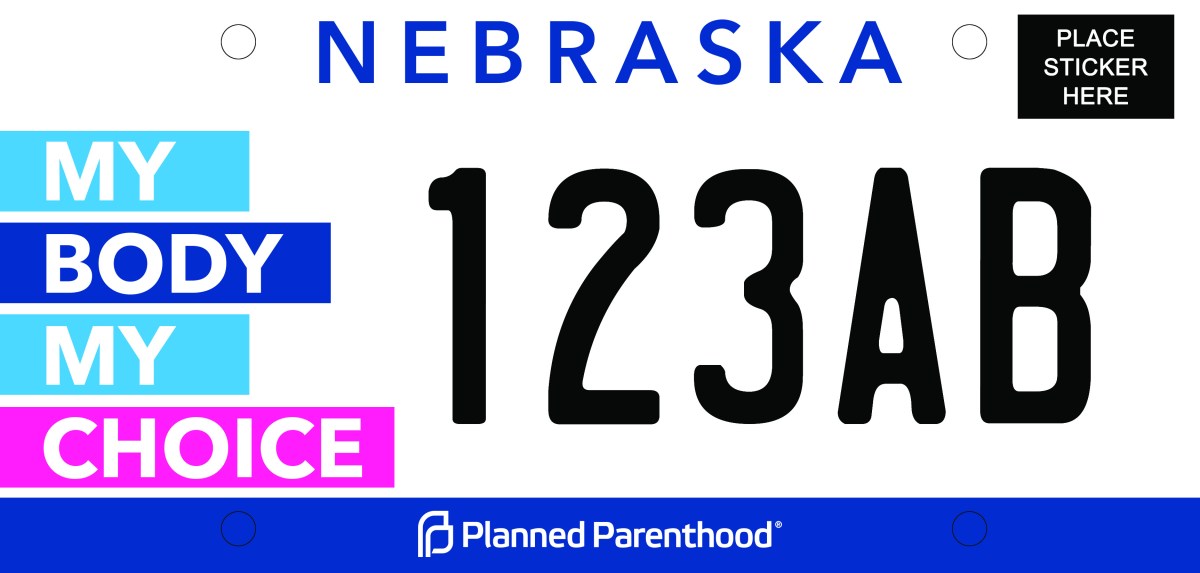
My New Planned Parenthood License Plate

If you had asked me a year ago if I would ever buy a vanity license plate, I would have given you an emphatic “no”. A license plate is utilitarian; its purposes are to identify your car for law enforcement and prove you paid your car taxes, but not much else. Political statements belong on bumper stickers or license plate holders. My license plate holders support Husker Women’s Basketball and Husker Baseball.

However, that changed forever in Nebraska when the Nebraska Legislature approved a “Choose Life” license plate and politicized license plates in Nebraska. During the debate on these plates, many senators argued that the plate was not political. However, that lie was exposed when Governor Ricketts signed the bill into law authorizing the new plates, calling it the first pro-life legislation signed into law in Nebraska since 2011.

Pro-life legislators conceded that the bill was necessary because they were not able to get 250 supporters to pay $70 each for a pro-life license plate.

However, those of us supporting Planned Parenthood believe that there are more than 250 people willing to pay $70 for a license plate supporting women’s right to choose. I have purchased my plate, and I encourage others to buy a plate and/or contribute $70 for an individual who would like this new plate but cannot afford it. You can purchase your plate or donate funds for others to have a plate here.

I believe in the resistance, and I believe it will be a long, hard four years ahead of us. We can take some joy in the Nebraska Unicameral standing up to the governor and reinstating funding for Title X clinics in Nebraska and in the election of two Democrats to the Lincoln City Council, including Bennie Shobe, a candidate endorsed by Planned Parenthood of the Heartland. But I can assure you that every day I drive my car with my “My Body, My Choice” Planned Parenthood license plate, it will put a smile on my face. Please join me.

Nebraska Unicameral Set to Defund Title X Clinics

What is Title X Funding? Title X is a federal grant distributed to states to fund family planning clinics, including contraceptive information and services, annual well-woman exams, STD testing and treatment and HPV testing and vaccinations. Low income men and women can access Title X services on a sliding fee scale. More information about Title X here.
The Nebraska Legislature is attempting to cut Title X funding for stand alone reproductive health clinics, and they’re doing it through the back door. The Legislature’s Appropriations Committee made a small, but crucial change to this year’s appropriations bill, LB327. That change prioritizes Federally Qualified Health Centers (FQHCs), hospitals, and local health departments for Title X Funding. Clinics that would not be prioritized and could lose their funding include
* Central Health Center in Grand Island and Kearney
* Family Health Services in Southeast Nebraska serving Crete, Lincoln, and other small communities
* People’s Family Health Services in North Platte
* Planned Parenthood in Omaha and Lincoln
Under this proposal, women in North Platte (where I grew up) would need to travel to Gering (172 miles) or Hastings (153 miles) to access Title X services. The clinics listed above currently serve 14,500 unduplicated patients and would lose over $1 million in federal funding. This is not a program which affects the Nebraska budget. The money is a pass-through from the federal government.
I believe it is clear that Governor Ricketts and Lt. Governor Foley are attempting to cut several family planning clinics out of the budget to support their personal anti-woman and anti-reproductive freedom agendas. They did not do it through a bill which would have required a public hearing on the matter. Instead, they inserted it (buried it) in the 138 page appropriations bill, hoping that no one would notice. The Appropriations Committee asked the Department of Health and Human Services (DHHS) to give the Committee a reason for the change from previous years’ Title X funding. DHHS has failed to provide that answer or a response. It is key to remember that DHHS works under the Executive branch of government, and their Director reports directly to the Governor.
Can FQHCs, hospitals, and local health departments serve the 14,500 patients currently being served by stand alone Title X clinics? FQHCs in Lincoln and Omaha have waiting lists; they refer their family planning patients to stand alone Title X clinics. Hospitals in many cities do not serve family planning patients. Many local health departments only provide vaccinations, not family planning serves. I do not believe these 14,500 patients can be served by other Title X providers.
This provision was debated in the Unicameral. Today on a 17-19 vote Senators voted down Amendment 1198 which would have eliminated this discriminatory provision. 25 votes are needed to amend the bill. As you can see from the vote today, many Senators chose not to vote. Senator Chambers then filibustered on the Motion to Reconsider Amendment 1198. After a very long day, LB327 advanced. There are still two more votes before the LB327 becomes final. Please call your State Senator and ask them to strike this offensive provision in LB327. Links to your Senator’s webpage can be found here.
The reproductive health of low-income men and women across the State of Nebraska is at stake. Please call your Senator before it is too late.

Why should we care about the Georgia 6th?

I live in the First Congressional District in Nebraska. Why should I care about the Georgia 6th?

Let me tell you a story. In 2008 I was diagnosed with early stage breast cancer. Breast cancer research got me an early diagnosis through a screening mammogram. DNA testing of my tumor showed that I only needed surgery & radiation treatment, not chemotherapy.  Nine years later I am still cancer free. I am grateful for the breast cancer research that occurred before my diagnosis and formed the basis for my treatment protocol.

In 2009 one of my closest friends, Myrta Hansen, died from endometrial cancer. I was sad; I was angry; and I wanted to do something bold and maybe just a little crazy. I found what I was looking for in the Susan G. Komen 3-Day for the Cure. For those of you who don’t know, the 3-Day is a 60 mile walk, 20 miles a day for 3 days. In addition, you have to fundraise in order to participate. I somehow talked my college roommate, Judith Siminoe, into doing it with me. We trained, individually since we live in different states. I even walked the Lincoln half marathon as part of my training. We raised money, and we talked to everyone we knew about the 3-Day. We told them that Komen raises money for breast cancer research and screenings. How could there be a better cause?

We did the 2010 walk in Seattle. For me it was a life changing experience, and I felt empowered and as though I had done something significant. Walking for three days with breast cancer survivors and people who had lost family members to breast cancer was incredible. Seattle

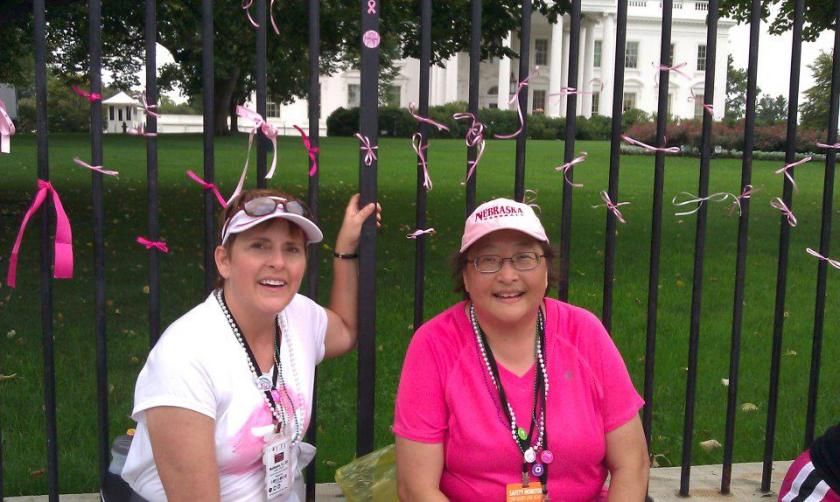
I signed up for the 3-Day in Washington, DC for 2011. My friend Marcia White agreed to walk with me, and four friends went to crew. Crew members work day and night to enable the walkers to complete their walk. We had torrential rain in DC, and those crew members were heroic in their efforts to keep our campsite free of mud. BTW who knew that rats ran out of the sewers in Chinatown and would run through the groups of walkers. Our walk ended at the White House and the Washington Monument.WhiteHouse

I signed up to walk the 3-Day in 2012. On January 31, 2012, the Komen Foundation announced they would no longer fund Planned Parenthood breast cancer screenings. I was just getting ready to start fundraising and training for the 2012 walk. I was shocked and angry; I followed Facebook late into the night as 3-Day walkers and other Komen supporters voiced their support for Planned Parenthood over the Komen Foundation. Hundreds of walkers vowed never to walk or raise money for Komen again; I was one of them. Andrea Mitchell interviewed Komen CEO Nancy Brinker in what became a PR disaster for Komen. The interview is here. An excellent analysis of the entire situation is here.

It soon became clear that Karen Handel, a newly hired Komen executive, was behind the move to cut Planned Parenthood off from future Komen funding. This is the same Karen Handel who is running against Jon Ossoff in the Georgia 6th. Part of my mission in this new normal is to do everything I can to make sure that the anti-choice, Planned Parenthood hating Karen Handel is not elected to any public office. An analysis of the Georgia 6th and Handel is here.

So I am asking you to consider a donation to Jon Ossoff’s campaign even if you don’t live in the Georgia 6th, because we all know we don’t need another anti-choice, Planned Parenthood hating congressional representative in the House of Representatives. #Flipthe 6th

And remember to vote in the Lincoln and Omaha general elections on May 2, 2017. I am endorsing Leirion Gaylor Baird, Bennie Shobe, and Maggie Mae Squires for City Council and Zachary James for Airport Authority.


Be Fierce! Be a Warrior!

Graham Spanier, former President of Penn State University, was convicted of one count of misdemeanor child endangerment on March 24, 2017. This is a first degree misdemeanor in Pennsylvania, and Spanier could receive up to five years in prison and a $10,000 fine. In my mind it is far too little and far too late, especially for the many victims of Jerry Sandusky, a child predator who was allowed to use the Penn State football facilities as a place to molest as many as 30 vulnerable children. This article at PennLive provides additional details of the conviction.

When this horrific situation first came to light, I tried to imagine what I would do. You see an adult male naked in a shower with a naked child that he appears to be touching or groping or something. I hope that I would have screamed at him to get away from the child, wrapped the child in a towel and called the police. I can understand (but do not condone) why football graduate assistant Mike McQueary who saw this scene did not do anything on March 1, 2002. He was young, and Sandusky was revered by the football department. This does not excuse the fact he did nothing for this child at the time he saw this incident. However, McQueary did tell his father what happened and reported it to then Penn State Athletic Director Tim Curley and then Penn State Vice President Gary Schultz.

Curley and Schultz both plead guilty to one count of misdemeanor endangering the welfare of children and agreed to testify against Spanier. They also face up to five years in prison and a $10,000 fine. Curley has stated: “I pleaded guilty because I felt like I should have done more,” and Schultz stated: “I felt I had been deficient in not reporting it myself.”

Curley and Schultz discussed the Sandusky situation with Spanier, and they all decided to basically do nothing. They characterized what was seen as “horseplay”. Seriously? How is a naked adult with a naked boy alone in a shower not a red flag for possible sexual abuse of a child? Curley, Schultz, and Spanier were seasoned administrators; they had a responsibility to that child, to every child who was assaulted after that date, to McQueary, and to Penn State to have done something about the situation in 2002. Instead, nothing about this ongoing sexual abuse became public until 2011.

I have heard people say that this could not have happened at their institution. I am sorry; they are naïve, delusional, and just plain wrong. This could happen at any institution; as long as people are willing to turn their heads and ignore or cover up wrongdoing.

Just ask Baylor University, a conservative Baptist University. Sports Illustrated wrote a detailed timeline of the problems at Baylor, which include allegations of sexual assault, domestic violence and other acts of violence involving several Baylor football players. Baylor’s situation could not have gone on so long without the collusion and cover up by the University and especially by the football program. Art Briles, head Football Coach, and Ken Starr, University President, were both eventually fired for their roles in this scandal. Technically, Starr resigned; but it is clear that was a forced resignation.

I have been a prosecutor; and as an Assistant Attorney General, I argued and briefed criminal appeals. I have read the trial transcripts for murder cases, sexual assaults, and child sexual assaults. I have seen the testimony of an entire family that they all slept every night on the floor of their teenage daughter’s room after she was sexually assaulted. The perpetrator threatened her by telling her that he would kill her family if she told anyone. She was too afraid to go to sleep because she was terrified for her family, so they all slept in her room.

I argued a case where a very small child’s testimony proved insufficient to prove that her stepfather sexually assaulted her. Between the trial and the Nebraska Supreme Court argument, the child’s mother committed suicide.

Terrible, horrific things happen, but these cases can only be prosecuted if someone comes forward to testify. If people look away or refuse to get involved, there can be no prosecution and no justice for these victims. And if these criminals are not prosecuted, they may go out and commit crimes against new victims.

My previous blog post discussed the proposed cuts to the Violence Against Women Act (VAWA) which could prove disastrous for victim services.

So I ask each of you, will you look away, or will you be fierce and speak up?


Priority One – Lincoln City Council Election – April 4, 2017

I was at a Planned Parenthood fundraiser Thursday night, and a wise woman told me that we as a community need to prioritize the upcoming Lincoln City Elections. She is absolutely correct. The primary election is April 4, 2017; the General Election is May 2, 2017. It is our first opportunity since the Presidential election to voice our preferences for elected officials, and we need to take advantage of that opportunity!

There are three at large seats open on the Lincoln City Council. Four Democrats, three Republicans, and one Independent are running for election. I encourage each and every one of you to do your own research on these candidates and make your own decisions.

I will tell you that I am supporting Leirion Gaylor Baird and Bennie Shobe, that includes giving them financial support as well as committing to vote for them. I am still doing my research to determine who the third candidate is that I will be voting for.

Democrat Leirion Gaylor Baird is an incumbent on the City Council. She has proven to be a strong advocate for Lincoln, and she is intelligent and steady. Check out her website and the Journal Star article about her.

Democrat Bennie Shobe is a community activist and says he will represent working people in Lincoln. Bennie is also a strong supporter of human rights, and that is very important to me. Check out his website and the Journal Star article about him.

Lou Bratz III is the third Democrat running for City Council. Check out his website and the Journal Star article about him.

Maggie May Squires is the fourth Democrat running for City Council. Check out her website and the Journal Star article about her.

Two City Council candidates’ forums were held last week, and there is an excellent article about them here. “Candidates were asked if they would support or advocate for Planned Parenthood to be listed as a resource on the city’s webpage regarding domestic violence and sexual assault, and if they would take proactive measures to help Planned Parenthood become part of the sexual assault-response team.” Shobe, Braatz, and Independent Deb Andrews all supported working with Planned Parenthood on domestic-assault issues. Gaylor Baird “supports including Planned Parenthood on a list of agencies but suggested there should be a statement on the website that this is not an endorsement of a particular viewpoint because of the controversy.” Supporting Planned Parenthood is very important to me, and these answers will help me decide the third candidate I will be voting for.

I encourage each of you to do your own research and decide who you support. If you have the means, support those candidates with financial donations. And most importantly, go VOTE on April 4!

Monday is the beginning of the Senate hearings on Judge Neil Gorsuch. For my thoughts on the Republican campaign to get him approved and on Judge Gorsuch, check out my previous post I Don’t Care What Jane Thinks!.

On Day 49 of the legislative session, the Nebraska Unicameral finally adopted their permanent rules for the session. The rules remain as they have for several years – it takes 33 votes to invoke cloture. This is a huge win for Senator Ernie Chambers and the progressives in the Legislature. Kudos to Senator Chambers’ tenacity in making this happen. More information is found in the Omaha World Herald article.

A big weekend for the Husker Softball and Baseball teams. After rough starts to the season, both teams went 3-0. Beautiful spring-like weather was an extra perk. Go Big Red!

Violence Against Women Act (VAWA)

In 1970 Lillian Hashiba Trimble was murdered by her husband. Lillian  grew up on the farm next to my mother’s family in rural Scotts Bluff County, Nebraska. The families were very close, and my mother and Lillian were close friends from childhood through college. At the time she was killed, I was a child, and my mother only told us that her friend had died, and the children were going to live with their maternal aunt and uncle. Always an inquisitive child, I know I asked my mother many times why the children could not live with their father; she just said he could not take care of the children. That did not make sense to my child’s mind and my personal experiences with a loving family.

I was in my twenties when my mother told me the whole story. Lillian’s husband shot her in front of their two children (ages 2 and 3), took the children to his sister’s home, and fled to Canada (they were living in New Jersey). He was later apprehended, extradited back to the US, and killed himself in prison.

I have two friends whose mothers were murdered, one by a stepfather, the other’s case remains an unsolved murder. Violence against women is not a new story. “In 2005, 1,181 women were murdered by an intimate partner. That’s an average of three women every day. Of all the women murdered in the U.S., about one-third were killed by an intimate partner.” National Organization for Women.

The National Coalition Against Domestic Violence defines domestic violence as: “the willful intimidation, physical assault, battery, sexual assault, and/or other abusive behavior as part of a systematic pattern of power and control perpetrated by one intimate partner against another. It includes physical violence, sexual violence, threats, and emotional or psychological abuse. The frequency and severity of domestic violence varies dramatically.” Every nine seconds a woman in the United States is beaten or sexually assaulted.

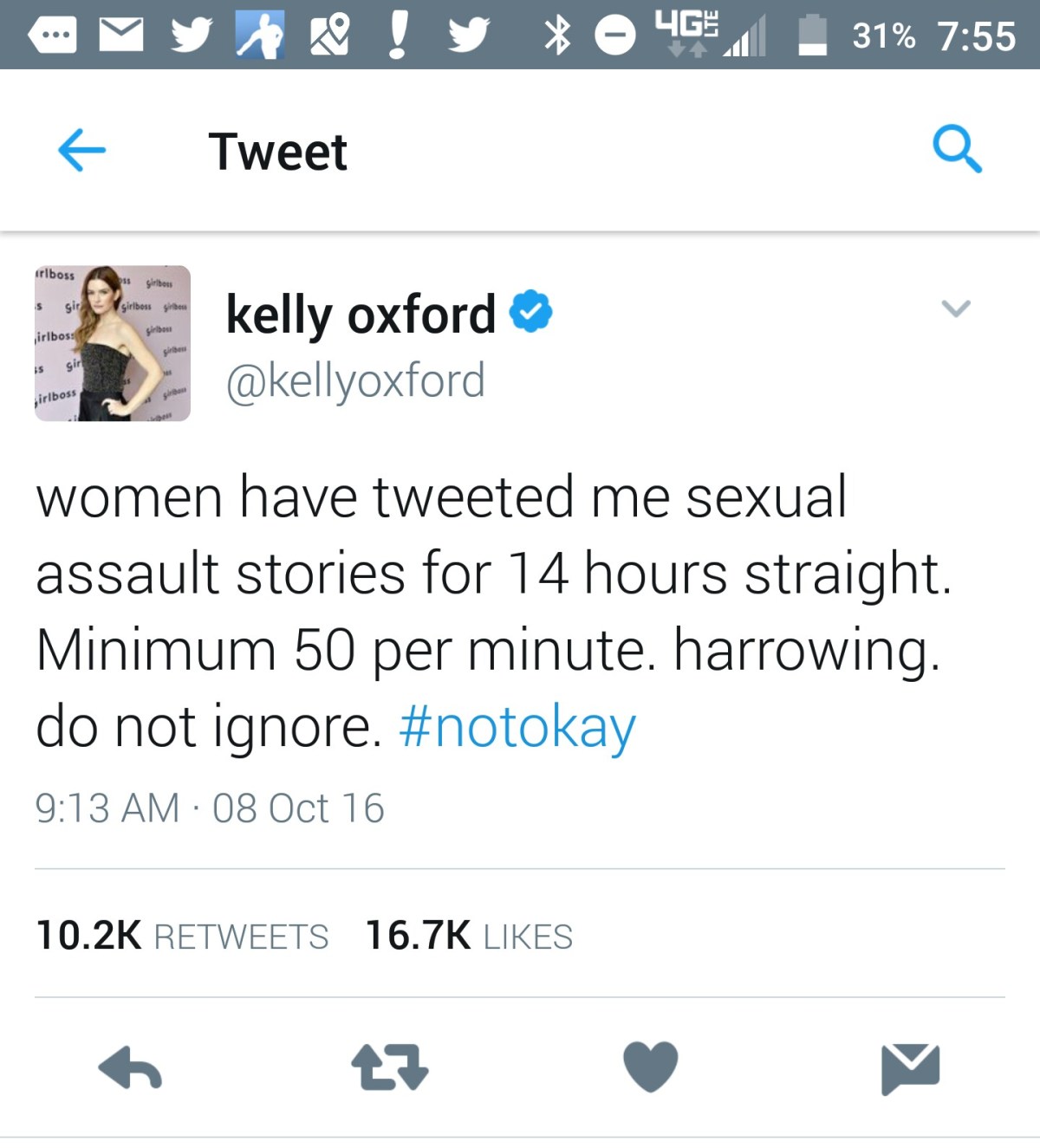
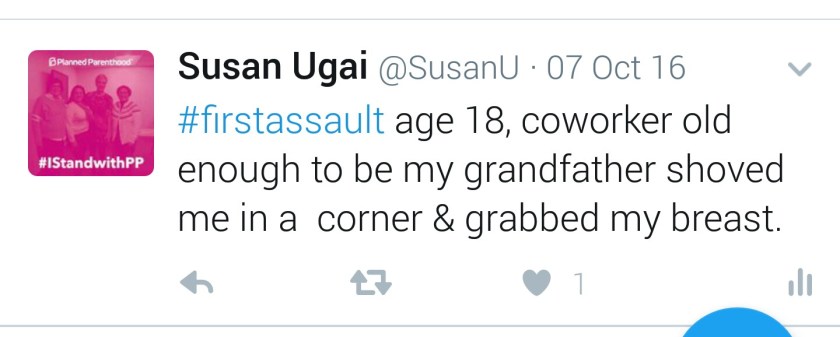
In early October, writer Kelly Oxford tweeted about the first time she was assaulted, at the age of 12 on a city bus when an older man grabbed her genitals. She asked others to tweet their experiences, using the hashtag #notokay. A million women responded. “Groped. Penetrated. Rubbed against. Exposed. Masturbated on. Stalked. Slapped. Raped. Forcibly kissed.” are some of the comments they tweeted.

img_20170305_200617

The outpouring of sharing moved me to share the information above, something which I had not shared before. As women we have all had our own experiences or know the experiences of friends and family who have been sexually assaulted and/or beaten.

The Violence Against Women Act was passed by Congress in 1994. “VAWA provides $1.6 billion over six years for education, research, treatment of domestic and sex-crime victims, and the improvement of state criminal justice systems. It also distributed funds to increase safety for women on public transportation, for shelters, and for youth education programs. In addition, it provides funds for the training of judges and other court personnel in combating gender bias in the courts, and also authorizes funding to pay the cost of testing for sexually transmitted diseases for victims of Sexual Abuse and to increase safety on college campuses.”

Federal grant funding to local governments to improve the keeping of crime statistics and for the protection of battered immigrant women and children is managed by the U.S. Department of Justice, now run by Attorney General Jeff Sessions, who voted against VAWA funding as a Senator in 2012.

“Last October, Sessions was asked about the controversial 2005 Access Hollywood video that showed Trump bragging about grabbing women’s genitals without their consent. ‘I don’t characterize that as sexual assault,’ he told the Weekly Standard. ‘I think that’s a stretch.’ […]”Daily Kos. Sessions appears to have forgotten everything he learned in law school. Trump’s comments definitely describe a sexual assault.

“Sessions has been silent on his plans for the Justice Department’s Office on Violence Against Women, which is responsible for enforcing VAWA and funding services for victims. But a blueprint from the Heritage Foundation—a powerful conservative group with close ties to the Trump team—calls for eliminating all Violence Against Women grants.” Daily Kos.

President Trump has indicated his intent to cut funding for the 25 VAWA grant programs currently administered by the Justice Department. Nebraska Governor Pete Ricketts’s proposed budget would cut state funding for violence against women programs in half.

Please consider donating to your local domestic violence and sexual assault prevention programs. In Lincoln, those programs are Voices of Hope and Friendship Home. Voices of Hope runs the crisis line for domestic violence, sexual assault, and incest; they also provide counseling, support groups, support victims in emergency rooms, accompany survivors to court, and assist in obtaining protection orders. Friendship Home provides safety planning, emergency shelter, and transitional services for domestic violence victims and their families.

Nebraska Legislature Update – Monday, March 6, 2017, is Day 41 of the session. The temporary rules have been extended until Day 50. No permanent rules have been passed. They spent 3 days last week discussing LB46A, an appropriations bill for the offensively political “Choose Life” license plate. Stay tuned to see if they can pass a budget in the remaining days.

Day of Remembrance

February 19, 2017, is the 75th anniversary of the signing of Executive Order 9066. February 19 is the Day of Remembrance in the Japanese-American community to remember the internment (imprisonment) of Japanese-Americans during World War II.

For more information follow @Densho on Twitter; Densho, George Takei, Day of Remembrance, and Allegiance on Facebook. These are just a start; there are many other good resources such as the Japanese American National Museum, Japanese American Service Committee of Chicago, and Densho.

I am sharing a speech I gave at the Tom Carroll Torch Club in Lincoln, Nebraska, on January 18, 2016. It was written as a speech so I left out all my citations. Please know that I did a lot of research for this paper and apologize for the lack of citations as I share this online.

2Minutes2Run

About six months ago I read a short essay by Neil Gaiman. It was written as part of Chipotle’s cultivating culture series where they place short essays on their drinking cups. Here is that essay:

“I am thinking about the fragility of civilization. Look around you, at the building you are in, the road you travel on. What you see was made by people who agreed that they would get up in the morning and go to work and nobody would shoot at them or fire mortars at them; there would not be checkpoints at which they could be taken out and never seen again; that there would be food in the shops, and water in the taps, and shoes to buy and to wear. People who believed that the place you go to sleep tonight will be here tomorrow.

There are now fifty million refugees in the world today, more than at any time since the end of the second World War. And at some point, for each one of those people, the world shifted. Their world, solid and predictable, erupted or dissolved into chaos or danger or pain. They realized that they had to run.

You have two minutes to pack. You can only take what you can carry easily. You are going to have to walk a long way. You hope that somewhere, someone is going to take you in. I have started to think of humanity as family: a family that quarrels, but which must, when things get hard, put aside old arguments and divisions, and care for each other. Sometimes someone needs somebody to take them in, and that’s the function of family. It’s time to care.

You have two minutes to run. What will you take with you?”

Recently politicians have irresponsibly advocated barring Syrian refuges from the United States and rounding up Muslims and Muslim-Americans and placing them in internment camps. When I first began hearing that, I thought, “What? Did I hear that right? Have we as a country learned nothing, absolutely nothing from our past?”

Let’s go back in history – it is December 7, 1941. Pearl Harbor has just been bombed.

That same day agents of the FBI swept through Japanese-American communities in California, Oregon and Washington, arresting leaders who were identified as “potential threats” to the security of the west coast. Those arrested were leaders of Japanese-American community organizations, ministers of churches, teachers at language and martial arts schools, and editors of Japanese-American vernacular newspapers. Despite never having been accused of any crime or acts of treason, and without trial or representation, they were taken away to United States Department of Justice detention centers, many for the duration of the war. Their families did not know where they were taken or if they would ever see them again.

On December 7, 1941, Rev. Hiram Kano had just said mass at the Church of Our Saviour Episcopal Church in North Platte, Nebraska. He was 180 miles from his wife and children at their Scottsbluff, Nebraska, home. But that morning he was arrested by the local police, taken to the police station, and dressed as a prisoner. He was not allowed to notify his family of his detention, but was sent to Omaha, Nebraska, to be dealt with by the district attorney. Rev. Kano spent the remainder of the war incarcerated with military prisoners, including soldiers who had been charged with crimes.

President Franklin D. Roosevelt issued Presidential proclamations 2525, 2526, and 2527 to authorize the United States to detain allegedly potentially dangerous enemy aliens. The FBI and other law enforcement agencies arrested thousands of suspected enemy aliens, mostly individuals of German, Italian, or Japanese ancestry, living throughout the United States.

The Department of Justice oversaw the processing of the cases and the internment program. Although many were released or paroled after hearings before a local alien enemy hearing board, for many the adversarial hearings resulted in internment that, in a few cases, lasted beyond the end of World War II. Of those interned, there was evidence that some had pro-axis sympathies. Many others were interned based on weak evidence or unsubstantiated accusations of which they were never told or had little power to refute. Often families, including naturalized or American-born spouses and children, of those interned voluntarily joined them in internment.

By the end of the war, over 31,000 suspected enemy aliens and their families, including a few Jewish refugees from Nazi Germany, had been interned at Immigration and Naturalization Services internment camps and military facilities throughout the United States.

These Presidential proclamations only addressed aliens or non-citizens. The 1870 naturalization act prohibited Japanese immigrants from naturalized citizenship. The 1907 Gentlemen’s Agreement between Japan and the United States halted immigration of unskilled workers from Japan. The Immigration Act of 1924 banned almost all immigration from Japan. Therefore, almost all Japanese citizens affected by this proclamation had been living in the United States most of their adult lives.

Anti-Japanese sentiment spread throughout the western United States, especially in California.

On December 16, 1941, J. Franklin Carter, a former news reporter and part of President Roosevelt’s informal intelligence network wrote to the President telling him that there was no substantial danger of fifth column activities by the Japanese and that he needed to reassure loyal Japanese and Japanese-Americans.

Assistant to the Attorney General, James H. Rowe, Jr. wrote that internment of Japanese citizens and their Japanese-American family members would require suspension of habeas corpus. He wrote that it was not the solution to the anti-Japanese hysteria in California.

In a meeting on February 1, 1942, Attorney General Francis Biddle stated that the Department of Justice would have nothing whatever to do with any interference with citizens or with a suspension of the writ of habeas corpus.

On February 4, 1942, before a Congressional subcommittee, Gen. Mark Clark, the Army’s Deputy Chief of Staff, said that he thought the Pacific states were unduly alarmed. While both he and Admiral Harold Stark agreed that the west coast defenses were not adequate to prevent the enemy from attacking, they also agreed that the chance of any sustained attack or of an invasion was-as General Clark put it-nil.

“In fact, no proved instances of sabotage or of espionage after Pearl Harbor among the west coast Japanese population were ever uncovered. “

“There were better if less tangible grounds for suspecting that some of the Japanese people-citizens as well as aliens-might become disloyal in the event of a Japanese invasion. The Navy report mentioned above indicated that a small but significant minority of the west coast Japanese could be expected to be highly undependable in a crisis; and subsequently the war relocation authority concluded that for this reason ‘a selective evacuation of people of Japanese descent from the west coast military area was justified and administratively feasible in the spring of 1942,’ although it concluded also that a mass evacuation such as was actually carried out was never justified.”

Within this setting Colonel Karl Bendetsen on February 4, 1942, wrote a long memorandum to General Allen Gullion that stated at the outset his conclusion that an enemy alien evacuation “would accomplish little as a measure of safety,” since the alien Japanese were mostly elderly people who could do little harm if they would. Furthermore, their removal would inevitably antagonize large numbers of their relatives among the American-born Japanese. After considering the various alternatives that had been suggested for dealing with citizens, Colonel Bendetsen recommended the designation of military areas from which all persons who did not have permission to enter and remain would be excluded as a measure of military necessity. In his opinion, this plan was clearly legal and he recommended that it be executed by three steps: first, the issuance of an Executive Order by the President authorizing the Secretary of War to designate military areas; second, the designation of military areas upon the recommendation of General Dewitt; and, third, the immediate evacuation from areas so designated of all persons to whom it was not proposed to issue permits to re-enter or remain. Colonel Bendetsen assumed that, if military areas were established on the west coast in place of the restricted areas thus far recommended by General Dewitt, about 30,000 people would have to be evacuated.”

Note that this called for evacuation only, not internment

The widely-read columnist Walter Lippmann publicized accusations of sabotage on the part of Japanese Americans in his syndicated column on February 12, 1942, titled “the fifth column on the coast”. These unfounded accusations fueled the California hysteria.

In a February 17, 1942, letter to President Roosevelt, U.S. Attorney General Francis Biddle said that over 60,000 of the Japanese-Americans are U.S. citizens . “My last advice from the war department is that there is no evidence of imminent attack and from the FBI that there is no evidence of planned sabotage”.

The Justice Department initially resisted any relocation order, questioning both its military necessity and its constitutionality. The Attorney General acquiesced after the war department relieved the justice department of any responsibility for implementation of the internment.

FBI director J. Edgar Hoover described the demands for internment as a “capitulation to hysteria” and told [treasury secretary] Morganthau that arrests should not be made “unless there were sufficient facts [probable cause] upon which to justify the arrests” He contended that the rights of American citizens should be protected, and protested the dragnet procedures. He was overridden.

On February 19, 1942, President Roosevelt signed Executive Order 9066, authorizing the forced removal and incarceration of more than 110,000 Japanese-Americans from the west coast. Families who were evacuated could only take what they could carry.

No martial law was ever declared, and there was never a suspension of habeas corpus.

Under the authority of Executive Order 9066, the western portions of California, Washington and Oregon were declared as military zones, and in April 1942, the military imposed a curfew and travel restrictions on Japanese-Americans. Singled out by race alone, Japanese-Americans became the target of racial policies that deprived them of their rights as American citizens. Soon after the curfew, the military posted notices in all Japanese-American communities, ordering all citizens and resident aliens of Japanese ancestry to abruptly leave their homes, schools and businesses and report to assembly areas, bringing with them only what they could carry. The government euphemistically referred to this program as an “evacuation” to “relocation centers,” when in fact it was the forced removal and incarceration of American citizens into concentration camps.

Under direction of armed police and the military, Japanese immigrants and Americans of Japanese ancestry were herded onto buses and trains for the forced journey to government detention camps. Without regard for due process or basic constitutional guarantees, over 120,000 persons of Japanese ancestry, two-thirds of whom were American citizens, (the issei – or first generation – were ineligible for citizenship due to discriminatory naturalization laws) were imprisoned in ten concentration camps located in remote, desolate areas in California, Idaho, Utah, Arizona, Colorado, Wyoming and Arkansas. Approximately 10,000 people were imprisoned in each camp surrounded by barbed wire and armed military guards.

There has been recent speculation on why President Roosevelt signed Executive Order 9066 after receiving information from both the Army and the FBI that the Japanese and Japanese-Americans did not pose a credible threat.

In a column written by the President for the Macon Telegraph on April 30, 1925, he wrote:

“Californians have properly objected on the sound basic ground that Japanese immigrants are not capable of assimilation into the American population.”

And “anyone who has traveled in the far east knows that the mingling of Asiatic blood with European or American blood produces, in nine cases out of ten, the most unfortunate results.”

This column may have shown some bias on the future President’s part.

In January 1943, the United States Department of War announced that Japanese American volunteers would be accepted for military combat duty in Europe. Most of the volunteers came from Hawaii, but there were also those who volunteered from within the concentration camps on the mainland. Japanese-American citizens were also drafted. The draftees and volunteers were assigned to a segregated Japanese American unit – the 442nd Regimental Combat Team. For its size and length of service, the 442nd eventually became the most decorated American unit in United States military history. In 2010 a Congressional gold medal was awarded to the 100th Infantry Battalion, the 442nd Regimental Combat Team and the Military Intelligence Service (MIS).

There is a much more complex story of resistance from individuals drafted from the internment camps and the requirements for internees to sign loyalty oaths, but that is a story for another day.

In 1943, the US Supreme Court upheld the convictions of Gordon Hirabayashi and Minoru Yasui for violation of a curfew against Japanese-Americans, both were us citizens.

On December 18, 1944, the US Supreme Court upheld the conviction of Fred Korematsu, a Japanese-American man and a US citizen who refused to submit to the exclusion order.

On December 18, 1944, the same date as the Korematsu decision, the US Supreme Court ruled in favor of Misuye Endo, a Japanese American woman and US citizen. This case was brought as a habeas corpus proceeding, and the court unanimously ruled that the United States government could not continue to detain a citizen who was “concededly loyal” to the United States. This case led to the end of the internment of all Japanese and Japanese-Americans.

In 1948 Congress passed the Japanese-American evacuation claims act. Internees could claim real and personal property losses that occurred as a consequence of the exclusion and evacuation. It did not allow for claims for lost income or for pain and suffering. Approximately $37 million was paid in claims, this amount was far below full and fair compensaton for actual economic losses because elaborate proof of loss was required and incentives for settling claims below their full value was built into the act.

In 1972 the Social Security Act was amended so that internees over the age of eighteen during their internment would be deemed to have earned and contributed to Social Security during their detention.

The Commission on Wartime Relocation and Internment of Civilians was established by an act of Congress in 1980. This Commission was directed to accomplish three tasks: (1) review the facts and circumstances surrounding Executive Order numbered 9066, issued February 19, 1942, and the impact of such Executive Order on American citizens and permanent resident aliens; (2) review directives of United States military forces requiring the relocation and, in some cases, detention in internment camps of American citizens, including Aleut civilians, and permanent resident aliens of the Aleutian and Ribilof islands, and (3) recommend appropriate remedies.

Recommendations were published by the Commission in June 1983 in a report called “personal justice denied”. The report found:

“In sum, Executive Order 9066 was not justified by military necessity, and the decisions that followed from it – exclusion, detention, the ending of detention and the ending of exclusion—were not founded upon military considerations. The broad historical causes that shaped these decisions were race prejudice, war hysteria and a failure of political leadership. Widespread ignorance about Americans of Japanese descent contributed to a policy conceived in hate and executed in an atmosphere of fear and anger at Japan. A grave personal injustice was done to the American citizens and resident aliens of Japanese ancestry who, without individual review or any probative evidence against them, were excluded, removed and detained by the United States during World War II.”

It is estimated that, as a result of the exclusion and detention, in 1945 dollars the internees lost between $108 and $164 million in income and between $41 and $206 million in property for which no compensation was made after the war under the terms of the Japanese-American evacuation claims act. Adjusting these figures to account for inflation alone, the total losses of income and property fall between $810 million and $2 billion in 1983 dollars. It has not been possible to calculate the effects upon human capital of lost education, job training and the like.”

“Less tangibly, the ethnic Japanese suffered the injury of unjustified stigma that marked the excluded. There were physical illnesses and injuries directly related to the detention, but the deprivation of liberty is no less injurious because it wounds the spirit rather than the body. Evacuation and relocation brought psychological pain, and the weakening of a traditionally strong family structure under pressure of separation and camp conditions. No price can be placed on these deprivations.”

“[O]ur nation’s ability to honor democratic values even in times of stress depends largely upon our collective memory of lapses from our constitutional commitment to liberty and due process. Nations that forget or ignore injustices are more likely to repeat them.”

“The governmental decisions of 1942 were not the work of a few men driven by animus, but decisions supported or accepted by public servants from nearly every part of the political spectrum. Nor did sustained or vocal opposition come from the American public. The wartime events produced an unjust result that visited great suffering upon an entire group of citizens, and upon resident aliens whom the constitution also protects.”

“The belief that we Americans are exceptional often threatens our freedom by allowing us to look complacently at evil-doing elsewhere and to insist that ‘it can’t happen here.’ recalling the events of exclusion and detention, ensuring that later generations of Americans know this history, is critical immunization against infection by the virus of prejudice and the emotion of wartime struggle. ‘It did happen here’ is a message that must be transmitted, not as an exercise in self-laceration but as an admonition for the future. Among our strengths as a nation is our willingness to acknowledge imperfection as well as to struggle for a more just society.”

On February 1, 1983, Minoru Yasui petitioned the Oregon Federal District Court for a writ of error coram nobis due to the discovery of the falsehoods promulgated by the Department of Justice. This writ is only available to people who have already completed their imprisonment, and can only be used to challenge factual errors from the case. Yasui claimed in his writ that the government withheld evidence at the original trial concerning the threat of a Japanese attack on the United States mainland. The court dismissed the original indictment and conviction against Yasui, as well as the petition for the writ on request by the government.

Fred Korematsu’s conviction for evading internment was overturned on November 10, 1983, after Korematsu challenged the earlier decision by filing for a writ of coram nobis. In a ruling by Judge Marilyn Hall Patel, the United States District Court for the Northern District of California granted the writ (that is, it voided Korematsu’s original conviction) because in Korematsu’s original case, the government had knowingly submitted false information to the Supreme Court that had a material effect on the Supreme Court’s decision.

In 1986 and 1987, Gordon Hirabayashi’s convictions for curfew violation and refusal to submit to the internment order were overturned by the U.S. District Court in Seattle and the federal appeals court, because evidence arose that the Solicitor General’s office (led by Charles H. Fahy) had cited examples of Japanese American sabotage in its 1943-44 Supreme Court arguments, despite having researched and debunked all the rumored incidents.

The Civil Liberties Act of 1988 awarded $20,000 to each individual interned during World War II. Payments began in 1990 and went first to the oldest individuals. Only those who were alive at the time the act was passed were eligible for the payments. The legislation stated that government actions were based on “race prejudice, war hysteria, and a failure of political leadership” as opposed to legitimate security reasons. A total of 82,219 individuals received redress checks from 1990 through 1993.

In 2009 the University of California system decided to offer honorary degrees to the approximately 700 Japanese American students who were forced to withdraw from school because of the internment. This included schools at Davis, Berkley, Los Angeles and San Francisco. John Kashiki from my father’s army unit received his honorary degree from UC-Davis, and someone many of you may know, Kim Hachiya, accepted an honorary degree on behalf of her father Keay from UCLA. Her Uncle George Hachiya received his honorary degree from Berkley.

In 2011, acting U.S. Solicitor General Neal Kumar Katyal publicly confessed his department’s ethical lapses in regard to the Japanese-American internment. In speaking of the internment, Katyal stated: “the solicitor general was largely responsible for the defense of those policies.”

“By the time the cases of Gordon Hirabayashi and Fred Korematsu reached the Supreme Court, the Solicitor General had learned of a key intelligence report that undermined the rationale behind the internment. The Ringle report, from the Office of Naval Intelligence, found that only a small percentage of Japanese Americans posed a potential security threat, and that the most dangerous were already known or in custody. But the Solicitor General did not inform the court of the report, despite warnings from Department of Justice attorneys that failing to alert the court ‘might approximate the suppression of evidence.’ Instead, he argued that it was impossible to segregate loyal Japanese Americans from disloyal ones. Nor did he inform the court that a key set of allegations used to justify the internment, that Japanese Americans were using radio transmitters to communicate with enemy submarines off the west coast, had been discredited by the FBI and FCC. And to make matters worse, he relied on gross generalizations about Japanese Americans, such as that they were disloyal and motivated by ‘racial solidarity.’”

“The Supreme Court upheld Hirabayashi’s and Korematsu’s convictions. And it took nearly a half century for courts to overturn these decisions. One court decision in the 1980s that did so highlighted the role played by the Solicitor General, emphasizing that the Supreme Court gave ‘special credence’ to the Solicitor General’s representations. The court thought it unlikely that the Supreme Court would have ruled the same way had the Solicitor General exhibited complete candor. Yet those decisions still stand today as a reminder of the mistakes of that era.”

It is highly unlikely that any of these remedies would have occurred without the relentless work of dedicated civil rights attorneys, and the sons and daughters (nisei) and grandsons and daughters (sensei) of Japanese-American internees who would not give up on these cases.

February 19 is the day of remembrance, an annual event held by the Japanese American community to commemorate the signing by President Roosevelt of Executive Order 9066 on February 19, 1942, which authorized the forced removal and incarceration of 120,000 Japanese Americans from the west coast during World War II.

And a new generation of Japanese-Americans is working hard to make sure we never forget what happened in 1942.

In 2012, ninth grader Matthew Shimura’s video the constitution and the camps: due process and the Japanese American internment won C-Span’s Studentcam Video Documentary Grand Prize. It is an excellent video and can be viewed on C-Span’s website.

Girl Scout Lauren Wong has created a special Girl Scout patch program for the Japanese American National Museum. She created an educational tool called experience the past, available in three separate worksheets geared toward elementary school students, middle school students, and high school students/adults. The worksheets, which can be requested at the Japanese American national museum’s front desk, are designed to accompany a visit to the museum’s core exhibition, common ground: the heart of community. They pose questions and suggest exercises that are designed to help visitors identify with the exhibition, think more deeply about what they’re seeing, connect it with aspects of contemporary life, and converse with others about their experience.

At the end of their visit, participants who complete a worksheet earn a custom patch that she created.

This patch is a reflection of the Japanese American community’s ties to girl scouting. According to a blog dedicated to chronicling Girl Scout history, Girl Scouts university, there were 743 Girl Scouts registered in the Topaz, Utah and Manzanar, California, concentration camps by December 1943.

However, in an interview with Densho, internee Shimako “Sally” Kitano recalled trying to rejoin a Bainbridge Island, Washington, Girl Scout troop upon her return but being told, “the kids are too far advanced now so I don’t think that you would fit in.”

Chief Justice Earl Warren, the architect of Brown v. Board of Education & other key civil rights decisions, was the Attorney General of California in 1941. He was an advocate of the internment. And in 1943, as Governor of California, he opposed the early release of Japanese Americans from internment, even though there was emerging sentiment for closure of the camps.

However, in his memoirs, Justice Warren voiced his regrets for his part in the internment. It is important to note that Warren voiced very few regrets about other parts of his career and was known as a man who never admitted he had been wrong.

Warren wrote that he had “since deeply regretted the removal order and my own testimony advocating it, because it was not in keeping with our American concept of freedom and the rights of citizens.” He then articulated his guilt feelings in terms that, for a father of six and a devoted family man, were vividly personal: “whenever I thought of the innocent little children who were torn from home, school friends, and congenial surroundings, I was conscience stricken.” On reflection, Warren believed that “[i]t was wrong to react so impulsively, without positive evidence of disloyalty. . . .”

So I leave you with the two questions we started with tonight – have we learned anything from our past? – and you have two minutes to run. What will you take with you?